Darcie’s story
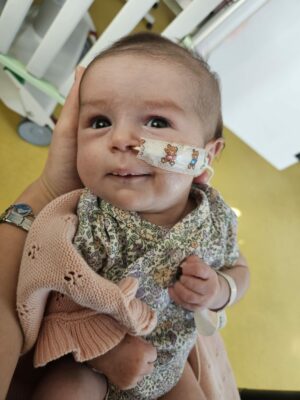 February 14th is about matters of the heart in more ways than one – because as well as being Valentine’s Day, it’s also Congenital Heart Defect Awareness Day.
Baby Darcie, from the Rhondda was diagnosed with a serious congenital heart defect before she was even born after an anomaly detected at mum, Jenna’s 20 week scan resulted in a referral to the foetal medicine unit. Frightened parents Jenna and Adam were told that their baby had Transposition of the Great Arteries (TGA) , a condition where the two main arteries leaving the heart are reversed. This means that, instead of pumping oxygen rich blood around the body to feed vital organs, the heart pumps the oxygen poor blood around it instead. Without surgery, the condition is life-threatening and the parents were told that their baby would need open heart surgery at just two weeks old.
Throughout the rest of the pregnancy, Jenna’s care was divided between her local hospital, the Noah’s Ark Children’s Hospital, Bristol Children’s Hospital and St Michael’s Hospital. Jenna was induced and baby Darcie was born at St Michael’s Hospital in Bristol.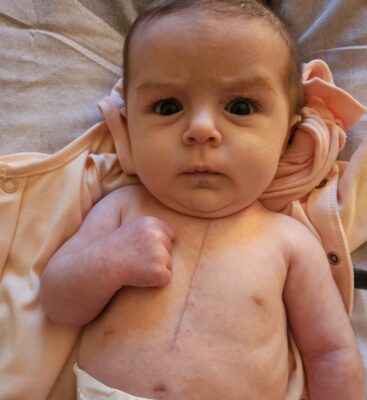
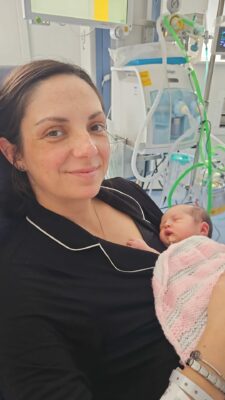
Jenna says it was a lovely birth and despite doctors’ concerns that Darcie might need breathing support, she arrived pink and crying. She was even able to have precious skin-to-skin time with her mum and dad before being taken to NICU.
Once on the unit, she was given Prostin, a medication that keeps a vital blood vessel, the ductus arteriosus, open. Keeping this duct open allowed blood to mix and circulate around Darcie’s body, helping stabilise her while plans for surgery were made. Shortly after, she was transferred to Dolphin Ward at Bristol Children’s Hospital to await surgery.
Scans showed the location of Darcie’s coronary arteries were unusual, making surgery more complicated so the decision was made to let her grow a little first. Fortunately, Darcie also had a large Ventricular Septal Defect (VSD), a hole between the lower chambers of the heart. In her case, this hole was helping oxygen-rich and oxygen-poor blood mix, allowing blood to reach her body rather than just circulating between heart and lungs. It was, unexpectedly, what helped get her home.
 Before discharge, the family went to the Noah’s Ark for home monitoring training. But just weeks later, Darcie’s parents noticed her oxygen saturations were dropping.
At seven weeks old, Darcie was readmitted and the cause of the change in Darcie became clear. As she was growing, the hole in her heart was becoming smaller meaning that her body could no longer get enough oxygen. Darcie’s saturation levels dropped to 40%, then 30%, and at one terrifying point, as low as 6%.
Darcie needed an emergency procedure to insert a catheter through her groin into her heart, where a balloon was used to enlarge the hole and allow blood to mix again.
After she was stabilised, at just nine weeks old Darcie underwent her first open heart surgery. It lasted nine agonising hours.
Jenna said: “We had no idea what was going on. It was the longest wait of our lives. We had to sign consent forms for two types of surgery because they wouldn’t know which one would be best until they were in theatre. Scans can only tell you so much.”
Darcie had an arterial switch operation, where the two main arteries were reconnected to their correct positions, along with closure of her VSD. She recovered well and, two weeks later, finally went home to her siblings. 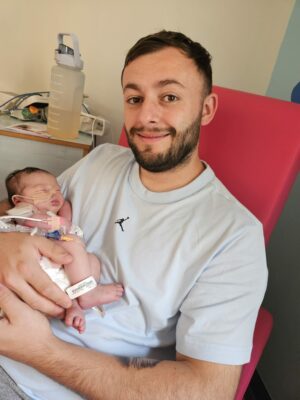
But her journey wasn’t over.
At six months old, Darcie began sweating profusely during feeds and tiring easily. Tests revealed that there was a narrowing in the pathway carrying blood from the right side of Darcie’s heart to the lungs. She also had leaking valves from her previous surgery, putting extra strain on her heart.
In September 2025, at just a year old, Darcie underwent her second open heart surgery where this time her surgeons attempted to relieve the obstruction. Unfortunately, they were unable to fully clear it so they fitted a conduit, a synthetic tube placed between the heart and pulmonary artery to allow blood to flow freely to the lungs.
Darcie’s recovery went well and just five days later, she was home.
But in November, Darcie started spiking temperatures. Initially thought to be tonsillitis, the antibiotics seemed to help at first, but Jenna knew that something wasn’t right. Darcie was exhausted, sweating again, had no appetite and was not herself.
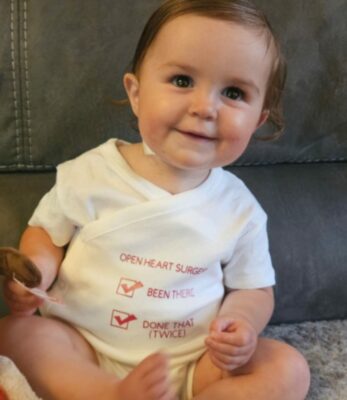 Blood cultures taken at Noah’s Ark showed that Darcie had endocarditis, a serious infection of the inner lining of the heart, often affecting artificial material like Darcie’s conduit. She needed a PICC line fitted for six weeks of IV antibiotics. Her liver function tests were raised and she started losing weight.
Jenna said: “It was so frightening to watch. She just became a different child. She had started to pull herself up and say ‘mam’ and ‘dad’ but she lost that because of the infection.”
But slowly, with treatment, Darcie’s sparkle has now returned.
Jenna said: “She’s smiling and laughing again and seeing her spark come back is amazing. The difference in her is incredible.”
When they first received Darcie’s diagnosis, Jenna and Adam had no idea what lay ahead. They hoped surgery would mean a few quiet years before the need for further surgery to fit a bigger conduit. Now, because of the infection, Darcie may need more surgery sooner than expected. 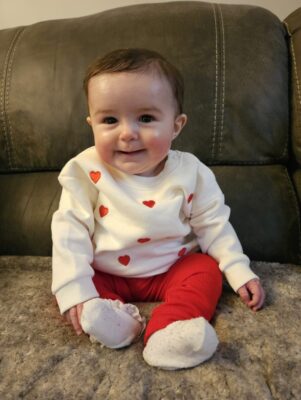
Darcie is almost finished her IV antibiotics and will continue six months of oral antibiotics to protect her conduit.
“We are so proud of everything she’s been through,” said Jenna. “Two open heart surgeries is enough for anybody, let alone an 18-month-old. Yet when you look at her you’d never guess her story. Despite it all she’s the most incredible, happy little girl with a truly infectious smile and laugh. We are so grateful for the amazing teams at Noah’s Ark and Bristol for looking after our girl.”
Around 13 babies are born with a congenital heart defect in the UK every day – that’s one in every 150 births. Thankfully due to early diagnosis, monitoring and advanced treatments, the outlook for most children is good. It’s thanks to you that the Noah’s Ark Charity is able to support the incredible work of the paediatric cardiology team here at the Noah’s Ark Children’s Hospital for Wales, helping to make sure that little sparks like Darcie are able to reach their full potential.