Jude’s story
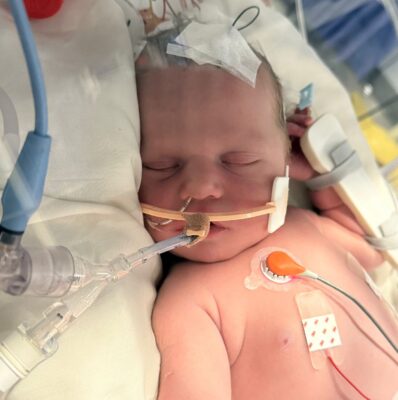 Fourteen-week-old Jude from Cardiff is the second child of Danielle and David. Danielle’s pregnancy was healthy and the delivery was quick. In fact, everything seemed fine until Jude was born not breathing.
David said: “The crash button was pressed and within ten seconds, 15 people flooded into the room, each knowing exactly what they needed to do to save Jude’s life.”
It was controlled urgency. Calm voices, clear roles and everyone moving with purpose.
Earlier that same morning, members of the NICU team had practised a very similar situation on a simulator mannequin, revisiting skills, rehearsing rare but critical scenarios. So when Jude needed them later that day, that training was no longer theory, it was instinct.
The NICU paediatric simulator mannequin was funded by the Noah’s Ark Charity thanks to the support of people like you. Since its arrival in March 2025, 28 simulations have taken place, refreshing and refining the skills of 159 clinicians, including nurses and doctors as well as midwives, obstetricians, anaesthetists, pharmacists and psychologists. Each scenario strengthens not only individual skill, but communication, leadership and teamwork under pressure, ensuring that, when a real-life situation does arise, little patients are given the very best chance of recovery. 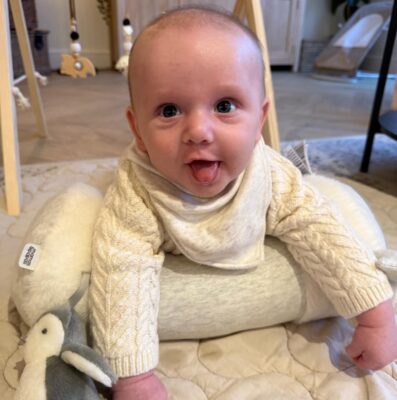
Baby Jude is one of those little patients. He was stabilised and transferred to NICU where he was ventilated for 24 hours. Finally after a very long week for his worried mum and dad, he was well enough to go home.
David said: “Without the skill, organisation, teamwork and passion of the team in NICU I am not sure Jude would be the healthy and happy baby boy that he is today. Their actions saved Jude’s life and for that I will be forever grateful.
“Without the quick response time from the team and the facilities available on the unit at the University Hospital for Wales, Jude may not be here.”
Thank you for supporting the Noah’s Ark Charity. It’s all thanks to you that we can continue to fund life-saving equipment and training so that clinical teams can respond quickly and to the very best of their ability when the moment comes.