Olivia and Grace’s story
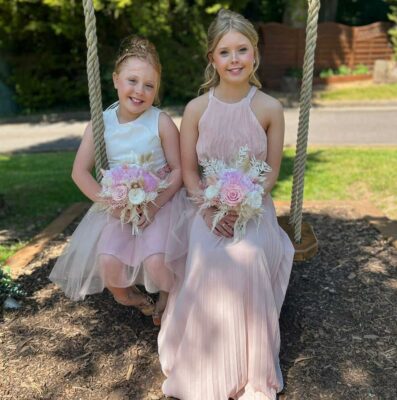 “It’s so tough and traumatic watching what our two children have to go through. Knowing they can have this treatment here, without pain or travel, has changed everything for our family.”
When Olivia was eight years old, her mum, Carla, started to notice some worrying changes. Olivia was unusually pale and complained of pain in her legs and abdomen. At first it was thought that she might be anaemic, but Carla felt instinctively that something more serious was going on. Olivia developed dark circles under her eyes and her urine became very dark, prompting Carla to insist on blood tests. Olivia had her bloods taken on a Wednesday morning, and that evening the family received a phone call telling them to go straight to A&E.
Olivia was admitted to Seahorse Ward at the Noah’s Ark Children’s Hospital for Wales before being transferred to Birmingham for a liver biopsy. She was diagnosed with Autoimmune Hepatitis Type 1, a rare condition in which the immune system attacks the liver, leading to inflammation, scarring and potentially liver failure if left untreated. Olivia also had an enlarged spleen affecting her bowel, portal vein hypertension and raised liver function tests. The diagnosis came during the COVID pandemic, making an already traumatic experience even more isolating for the family. Because Olivia was being treated on a transplant unit, dad, Matthew, wasn’t allowed on the ward and the family was separated at a time when they needed each other most.
Olivia’s treatment started immediately, but the first six months were extremely hard. The family were in and out of hospital, and there were ongoing discussions about whether Olivia might need a liver transplant. Thankfully, Olivia responded to treatment and, although she still requires regular infusions and careful monitoring, she is now stable.
Because of Olivia’s diagnosis, her little sister, Grace, was also kept under close surveillance, as there was a possibility that the condition was hereditary. The thought of having two children with a chronic lifelong liver disease was terrifying for Carla and Matt, but sadly it was a reality that they were soon to face. During the summer holidays in 2024, Grace became seriously unwell with a staphylococcal infection and was ill for the entire six-week break. A liver biopsy in Birmingham confirmed the family’s worst fears – Grace had Autoimmune Hepatitis Type 1 too. Thankfully, because of Olivia’s diagnosis, Grace’s condition was caught early. Carla says she is so grateful that Grace never became as unwell as her older sister.
Until recently, monitoring liver disease meant invasive liver biopsies under general anaesthetic or exhausting and costly journeys to Birmingham or London for less invasive treatments. But all of that changed when, thanks to people like you, the charity was able to fund a paediatric fibroscan probe for the Noah’s Ark Children’s Hospital for Wales. The fibroscan works by sending sound waves into the liver and measuring the echoes that return, allowing clinicians to assess liver stiffness, scarring, cirrhosis and fat deposition without surgery or anaesthetic. It is quicker, safer and far less distressing for children and families, and has become the international standard of care for patients whose condition may progress to fibrosis or cirrhosis.
With the introduction of this new equipment and specialist training, clinicians at Noah’s Ark can now perform fibroscans in the consultation room, using different sized probes designed specifically for children. Over the past 12 months, 47 children have already been scanned, including 16 babies, and the device is expected to help many more children over the years to come.
In October 2025, both Olivia and Grace had fibroscans at Noah’s Ark. The results showed that Olivia’s liver had improved and that Grace’s condition was stable. For Carla and her family, being able to have these scans locally has made a huge difference. It means no travelling long distances, no general anaesthetic, no liver biopsy, less trauma for the girls, and far less time away from school and work. They’re also able to access the new technology in a child-centred hospital that feels familiar and safe to them.
Although Olivia and Grace continue to be jointly cared for by specialists in Birmingham and the team at the Noah’s Ark Children’s Hospital for Wales, fibroscan monitoring allows their condition to be reviewed safely, regularly and locally.
Carla said: “ We’re incredibly grateful to supporters of the Noah’s Ark Charity for making this possible – not just for our girls, but for so many children across Wales.”